
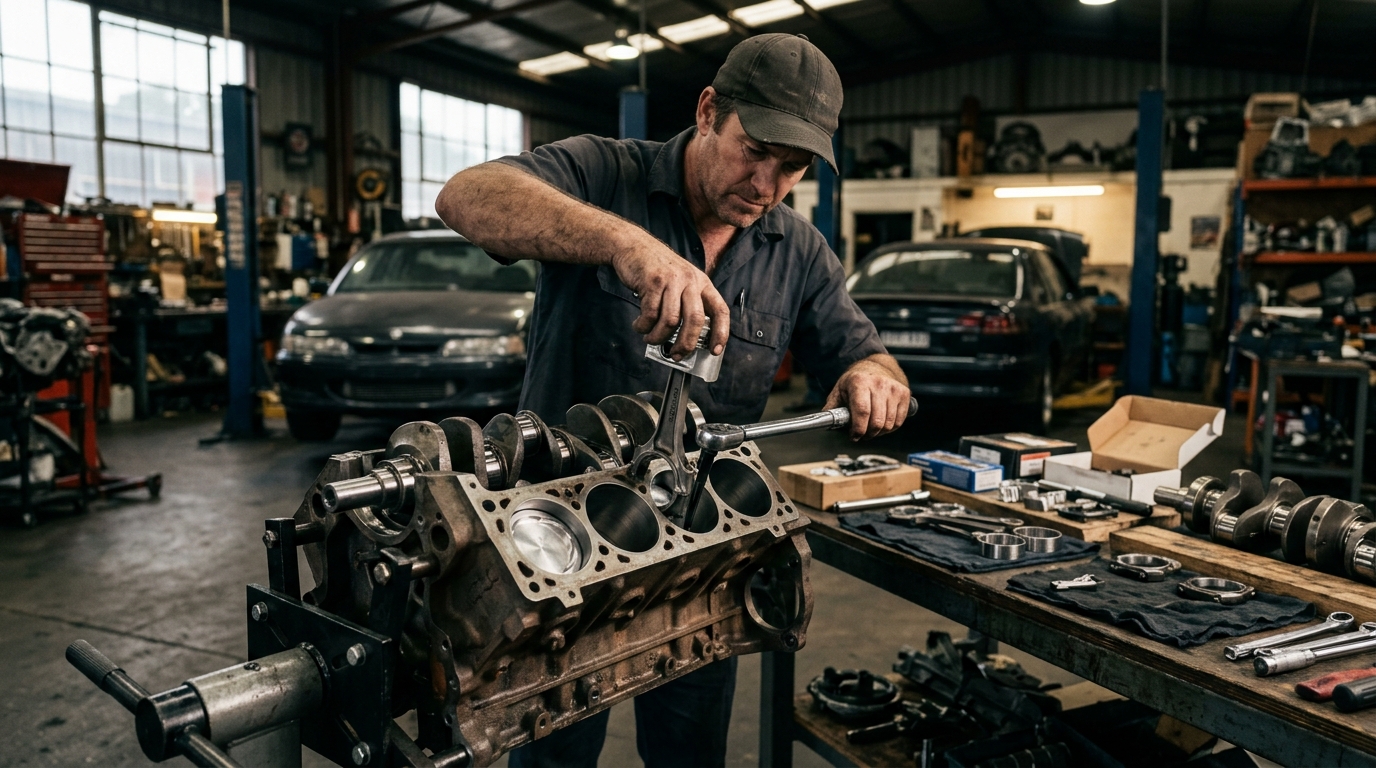
Stroking a Holden 304 or 308 to 355 cubic inches is one of the most popular and cost-effective performance upgrades in the Australian V8 world. A stroker kit increases the engine's displacement by lengthening the piston stroke, unlocking serious gains in torque and horsepower without changing the external footprint of the engine. This guide walks you through every stage of the process — from choosing the right kit to final assembly and tuning.
Why Stroke Your Holden 304 or 308?
The Holden V8 has long been a favourite of Australian performance and muscle car enthusiasts, and these Aussie-built powerplants are ripe for performance upgrades. A stroker kit provides a notable displacement increase, resulting in enhanced torque and overall performance. As the old saying goes, there is no replacement for displacement.
When you stroke a Holden 304 (5.0L) or 308, the result is typically a 355 cubic inch engine when bored +0.030 over, or roughly 350 cubic inches at the standard bore size. Done right, 400–450 hp is easily achievable, especially if you go down the roller cam route. The enhanced torque delivery improves acceleration, making it thrilling to drive on both the open road and the racetrack.
Step 1: Select the Right Block
You can use any 1969–2000 Holden 308 or 304 block as a foundation for a 355 stroker. Later-model blocks from the late 1980s onwards (VN, VR, VS series) tend to have slightly better metallurgy and are generally recommended. Earlier blocks may actually be simpler from a pollution-equipment standpoint, but any generation will work with proper machining.
Block Inspection Checklist
- Check for cracks, especially around the main webs and cylinder bores
- Measure bore wear — if the bores are still within specification you have more overbore options
- Confirm the rear main seal style (rope seal vs neoprene) to ensure crankshaft compatibility
- Verify bellhousing bolt pattern (Trimatic vs TH pattern) for your transmission
Step 2: Choose Your Stroker Kit Components
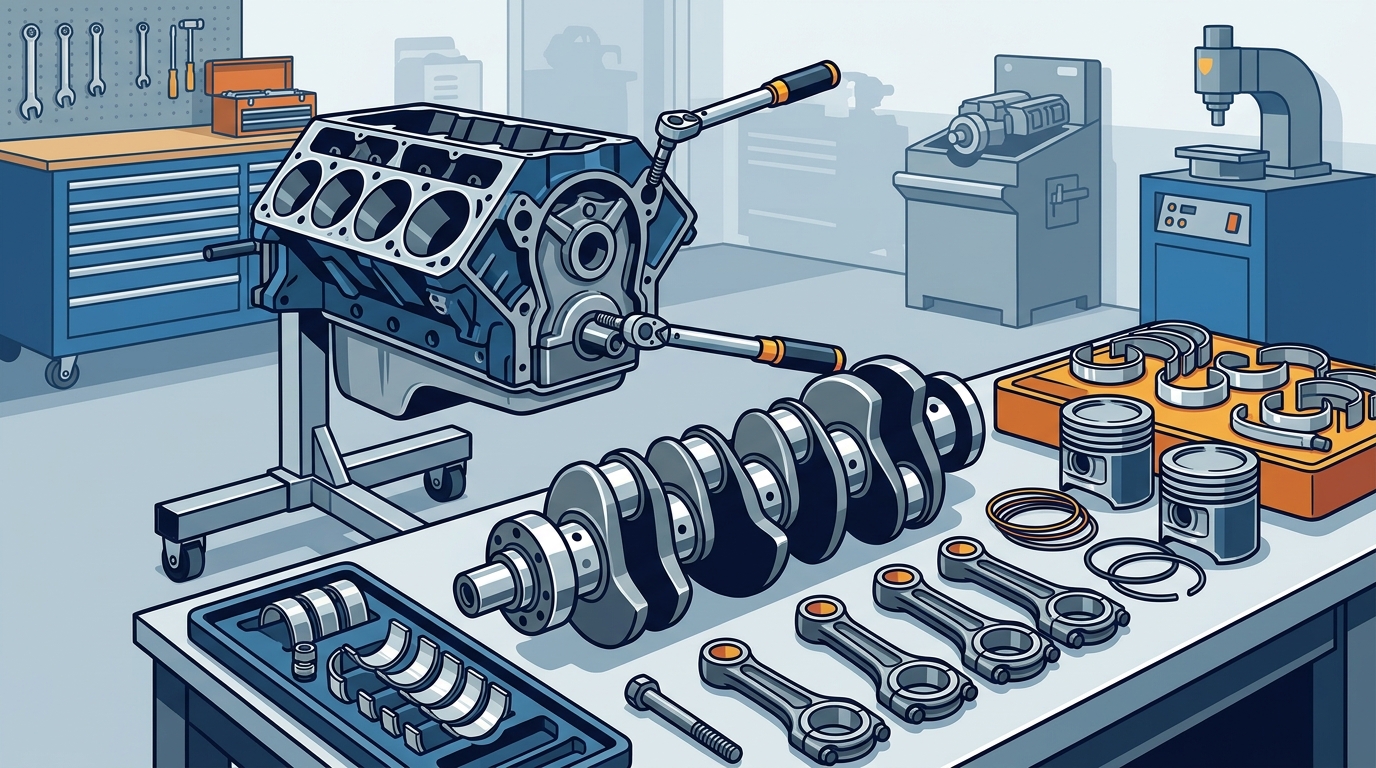
A complete 355 stroker kit typically includes a crankshaft, connecting rods, pistons, rings, and bearings. Premium kits from brands like Scat, paired with Racetec or Autotec forged pistons, are leaders in this field.
Crankshaft Options
The most popular stroker crank is a 3.480-inch stroke unit, available in both cast nodular iron (Scat 9000 series) and forged 4340 steel. There are two main conrod journal size options: the Holden 304/308 journal at 2.124 inches, and the Chevy large journal at 2.100 inches. The Chevy journal cranks open up access to a wider range of affordable connecting rods and bearings from the US market.
Be aware that a Chevy-journal crank may need Mallory metal (heavy metal) to achieve proper balance when using 5.7-inch rods, or alternatively you can run a 6-inch rod and lighter piston combination to balance more easily.
Connecting Rods
The two standard rod lengths for a 355 stroker are 5.700 inches and 6.000 inches. H-beam connecting rods manufactured from 4340 chromoly steel are the preferred choice for performance builds. These rods are typically x-rayed, ultrasonically tested, shot-peened and stress-relieved. They also feature doweled caps for precise alignment and are profiled with extra clearance for stroker applications. ARP rod bolts (7/16-inch or 3/8-inch 8740 grade) are standard in quality kits.
A set of Scat 5.7-inch or 6-inch rods can be purchased for less than reconditioning a set of factory A9L rods, making the stroker route surprisingly cost-effective.
Pistons
You need pistons with the correct compression height (pin height) to match your stroke and rod length combination. Common piston options include:
- Hypereutectic — Aluminium alloy with 16% silicon for greater strength and wear resistance; suited to mild street builds
- Forged (SRP, CP, JE) — Essential for high-performance, supercharged, or nitrous applications
Flat-top pistons are the most common choice. Dish options (5cc, 12cc, 16cc, or 31cc) are available to fine-tune compression ratio. When using Chevy-pattern pistons, small valve reliefs are present but do not affect performance.
Step 3: Machine the Block
Block machining is a critical phase. You will need to get the block bored and honed to suit the new pistons, deck heights checked and machined to achieve the correct compression height, and the rotating assembly balanced.
Key Machining Operations
- Bore and torque-plate hone — Bore to the required oversize (+0.030 for a true 355 ci) with a torque plate fitted to simulate head bolt stress for a perfectly round bore
- Deck the block — Machine the deck surface flat and to the correct height so piston-to-deck clearance is consistent across all eight cylinders
- Clearance grinding (relieving) — The stroker crank's longer throw means the big-end and counterweights swing closer to the block walls and oil-pan rail. You will likely need to clearance-grind the block's internal webbing so the crank and rods rotate freely
- Tunnel hone — Ensures the main bearing bores are perfectly aligned and round after any block flexing or previous use
- Cam bearing installation — Remove the old cam bearings and press in new ones
- Rear main seal conversion — If using a rope-seal block with a neoprene-seal crank (or vice versa), you may need a conversion
Have the machine shop dummy-assemble the rotating assembly to verify compression ratio, piston-to-valve clearance, and rod-to-block clearance before final assembly.
Step 4: Assemble the Bottom End
With all machining complete and parts back from balancing, it is time to assemble the short block.
Assembly Sequence
- Install freeze (welsh) plugs and oil gallery plugs
- Fit new cam bearings
- Install the crankshaft with new main bearings — check bearing clearances with Plastigage (target 0.002–0.003 inches for mains)
- Install ARP main studs or bolts and torque to specification
- Fit a main stud girdle if your combination calls for one (recommended for high-power builds)
- Assemble piston and rod assemblies — install rings with correct end gaps (file-fit recommended)
- Use a quality ring compressor and install pistons into bores
- Torque rod bolts to ARP specifications
- Check crankshaft end-play and rod side clearance
- Install the oil pump (JP or Melling high-volume recommended) and pick-up screen
Step 5: Top-End Components — Heads, Cam and Intake
The bottom end is only half the story. Your cylinder head, camshaft, and intake manifold choices will determine how much of the stroker's potential you actually realise.
Cylinder Heads
A quality pair of Edelbrock Holden 304 alloy cylinder heads or CNC-ported Holden VN heads can bring about a significant increase in airflow and power. VN through VS-III heads are the most commonly used factory heads and fit directly onto earlier (1969–1987) blocks as well. CNC porting of factory Holden 304 heads can support power levels from 500 hp to 600 hp and beyond.
If running a big cam, you will be better off with screw-in rocker studs and upgraded valve springs. Stud-mount roller rockers — such as Yella Terra or Crane Gold units — are a worthwhile upgrade for valvetrain stability at high RPM.
Camshaft Selection
Match your camshaft to the intended use of the vehicle. A hydraulic roller cam offers excellent streetability with modern reliability. Brands like Comp Cams, Crane, and Crow Cams all offer profiles specifically ground for the Holden 355 stroker combination. A cam with more duration and lift will make more top-end power but will sacrifice low-RPM idle quality and vacuum — choose based on your priorities.
Intake Manifold
The factory banana-style intake manifold will become restrictive very quickly with a decent 355 combination underneath it. Upgrading to an aftermarket manifold — such as an Edelbrock Performer or a single-plane high-rise unit — is essential for extracting the full potential of the stroker. A dual-plane manifold suits street-driven cars; a single-plane is better for higher-RPM race applications.
Step 6: Supporting Modifications
A stroker engine does not operate in isolation. Ensure these supporting systems are addressed:
- Harmonic balancer — Fit a Powerbond or equivalent balancer matched to your new rotating assembly's balance factor
- Flexplate or flywheel — A DRP or SFI-rated flexplate matched to the stroker's balance is critical
- Timing chain — A Rollmaster or Crow dual-row timing set provides precise cam timing and durability
- Oil system — High-volume oil pump, windage tray, and if clearance allows, a sump brace or girdle
- Exhaust — Extractors (headers) and a free-flowing exhaust system are essential to avoid choking the engine
- Cooling — Ensure your radiator and water pump are up to the task of managing the extra heat output
Step 7: Professional Tuning
Proper tuning after installation of the stroker kit is imperative to ensure optimal performance. An experienced tuner can extract the most from the engine by adjusting fuel maps, ignition timing, and other engine parameters. Whether you are running a carburettor or EFI, a dyno tune is strongly recommended. This is where the real power is found — or lost.
Typical 355 Stroker Kit Components List
| Component | Typical Specification |
|---|---|
| Crankshaft | Scat 9000 cast or 4340 forged, 3.480" stroke |
| Connecting Rods | Scat H-beam 5.7" or 6.0", 4340 chromoly, ARP bolts |
| Pistons | Forged (SRP/CP/JE) or hypereutectic, flat top or dish |
| Rings | Speed Pro moly or plasma-moly file-fit |
| Main Bearings | ACL Race or King XP series |
| Rod Bearings | Clevite 77 or King XP narrow |
| Main Studs | ARP main stud kit |
| Gasket Kit | ACL full gasket set with Felpro race head gaskets |
Budget Considerations
A complete stroker rotating assembly kit starts from around $1,600–$2,700 AUD depending on quality and whether you opt for cast or forged components. Machining costs (bore, hone, deck, balance, clearance grinding, cam bearings, and related work) can add $3,000–$5,000 or more to the project. Factor in heads, cam, intake, and supporting components and a full 355 stroker build can range from $8,000 to $15,000+ depending on the level of specification.
It is worth noting that a stroker build is not dramatically more expensive than a standard-stroke rebuild, because you still need to machine the block and source pistons either way. Finding good pistons to suit a standard-stroke 304 or 308 is not that easy or cheap, whereas the stroker market benefits from wider parts availability.
Key Takeaways
- A 355 stroker is the most popular and cost-effective displacement upgrade for Holden 304 and 308 engines
- Use a 3.480-inch stroke crankshaft and bore the block +0.030 over for a true 355 cubic inches
- Block clearancing is essential — the stroker crank and rods need room to swing freely inside the block
- Match your rod length and piston compression height carefully to your crankshaft stroke
- Quality parts from brands like Scat, SRP, ARP, and ACL are proven in thousands of Australian builds
- Cylinder heads, camshaft, and intake manifold upgrades are necessary to realise the stroker's full potential
- Professional balancing and tuning are non-negotiable for reliability and performance
- Total cost is only marginally more than a stock-stroke rebuild, making the stroker the smarter investment
Frequently Asked Questions
Can I use any Holden V8 block for a 355 stroker?
Yes. Any 1969–2000 Holden 308 or 304 block can be stroked to 355 cubic inches. Later-model blocks (VN onwards) are generally preferred for their improved design, but all generations work with proper machining and clearancing.
What is the difference between a cast and forged stroker crankshaft?
Cast nodular iron cranks (such as the Scat 9000 series) are more affordable and perfectly adequate for street and mild performance builds. Forged 4340 steel cranks are stronger and recommended for high-horsepower, boosted, or competition engines.
Do I need to clearance the block for a stroker kit?
In most cases, yes. The longer stroke means the crankshaft counterweights and connecting rod big ends swing closer to the block's internal webbing. Clearance grinding by an experienced machinist ensures nothing contacts during rotation.
What rod length should I choose — 5.7 or 6.0 inches?
Both work well. A 5.7-inch rod uses a taller piston (higher compression height) and is the more common budget-friendly option. A 6.0-inch rod uses a shorter, lighter piston which can be easier to balance and is gentler on cylinder walls, but the overall engine package is slightly taller.
Is a 355 stroker reliable for daily driving?
Absolutely. With quality components, correct machining tolerances, proper assembly, and professional tuning, a 355 stroker is just as reliable as a stock engine. Many enthusiasts run them as daily drivers in Commodores and Toranas across Australia.
Where can I buy a Holden 355 stroker kit in Australia?
Total Performance stocks a wide range of Holden 355 stroker kits using Scat crankshafts and connecting rods, paired with forged or hypereutectic pistons to suit your build and budget. Contact the knowledgeable team for expert advice, competitive pricing, and fast delivery.