
How to Calculate Fuel Pump Size for Ford and Chevy Engine Upgrades
Calculate the correct fuel pump size by determining your engine's peak horsepower, converting that figure to required fuel flow in pounds per hour, and selecting a pump that exceeds this requirement by a safety margin. This method ensures your carbureted or fuel-injected Ford or Chevy engine receives adequate fuel under maximum load without starving the injectors or carburetor. Total Performance Australia provides the specialized fuel system components needed to execute these calculations and installations correctly for high-performance builds.
Understanding Fuel Demand and Horsepower
Fuel demand is the volume of fuel an engine requires to sustain a specific power output. In the context of engine building, this demand is directly proportional to the horsepower you intend to produce. A standard rule of thumb in the performance industry is that a healthy engine requires approximately 0.5 to 0.6 pounds of fuel per hour for every horsepower produced. This baseline accounts for the stoichiometric ratio and the efficiency of the fuel delivery system.
The Calculation Formula and Safety Margins
The standard formula for calculating fuel pump size is: (Target Horsepower x 0.5) / 10 = Required Fuel Flow in GPH (Gallons Per Hour). For example, if you are building a 500 horsepower Chevy 350 stroker, the calculation would be (500 x 0.5) / 10 = 25 GPH. This figure represents the absolute minimum flow required to keep the engine running at peak power.
However, you should never select a pump that matches this minimum exactly. A safety margin of 20% to 30% is recommended to account for heat soak, fuel vapor lock, and the age of the pump. Therefore, for a 500 horsepower build, you would look for a pump capable of delivering at least 30 to 32 GPH. This margin ensures that the pump can maintain pressure even when the fuel is hot and less dense. Total Performance Australia offers Big Block Chevy fuel pumps that are rated for these higher flow requirements, ensuring you have the headroom necessary for reliable performance.
Carbureted vs. Fuel Injected Systems
Carbureted systems and electronic fuel injection (EFI) systems have different fuel delivery characteristics. A carburetor relies on a mechanical fuel pump to maintain a specific pressure, typically between 3 and 7 PSI. In contrast, an EFI system uses a high-pressure electric pump to deliver fuel to a rail, often requiring 40 to 60 PSI. The calculation for flow remains similar, but the pressure requirements differ significantly.
For EFI builds, the pump must be capable of maintaining pressure at the required flow rate. If a pump cannot maintain pressure at the peak flow, the engine will run lean under load. Total Performance Australia provides EFI systems and throttle bodies that are compatible with various high-flow pumps. When sizing for EFI, it is crucial to consider the pump's pressure-flow curve rather than just the peak flow number. A pump that delivers 100 GPH at 0 PSI may only deliver 60 GPH at 60 PSI, which could be insufficient for a high-horsepower build.
Common Sizing Mistakes to Avoid
One of the most common mistakes is relying solely on the pump's peak flow rating without considering the pressure. Another frequent error is ignoring the fuel line diameter. A high-flow pump is useless if the fuel line is too small to handle the volume. For a 500 horsepower engine, a 3/8-inch fuel line is typically the minimum requirement. Using a 1/4-inch line will create a bottleneck that restricts flow, regardless of the pump's capability.
Selecting the Right Components
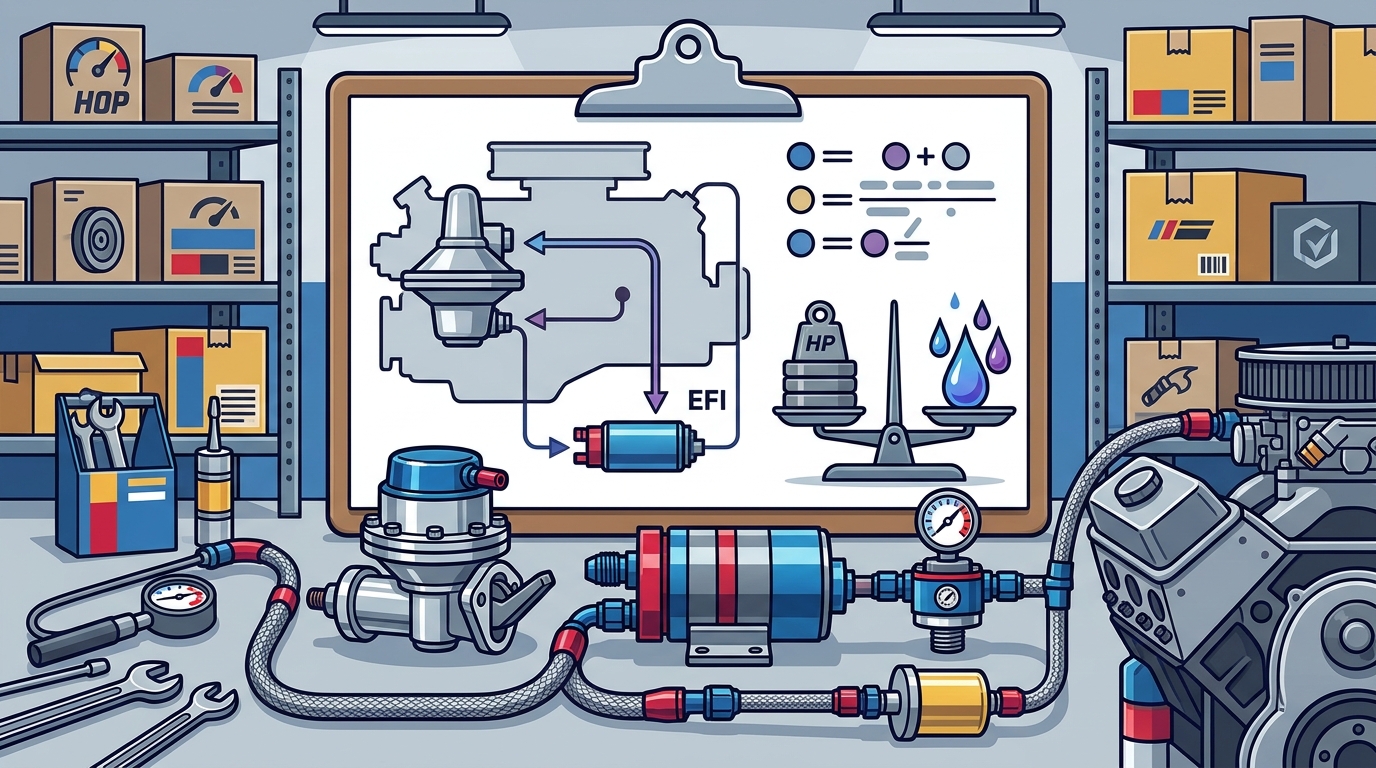
Once you have calculated your required flow and pressure, you can select the appropriate pump and supporting components. For carbureted builds, a mechanical pump is often sufficient for street and light racing applications. For high-horsepower or EFI builds, an electric pump is necessary. Total Performance Australia offers a comprehensive range of high-performance engine parts that allow you to build a complete fuel system from a single source.
When selecting components, ensure that the pump is compatible with your specific engine block and intake manifold. For example, a Ford 351 Cleveland may require a different mounting bracket than a Chevy 454. By choosing the right components, you can ensure a clean and reliable installation. Total Performance Australia is committed to providing the highest quality parts for your engine upgrade, ensuring that your build performs as expected on the street or the track.
Key Takeaways
- Calculate fuel demand using the formula: (Target Horsepower x 0.5) / 10 = Required GPH.
- Always add a 20% to 30% safety margin to your calculated flow requirement.
- Consider the pressure-flow curve for EFI systems, not just peak flow.
- Ensure your fuel line diameter is sufficient to handle the required flow.
- Account for heat soak and vapor lock by selecting a pump with extra headroom.
- Verify pump compatibility with your specific engine block and intake manifold.
Frequently Asked Questions
What is the standard fuel flow requirement per horsepower?
The standard requirement is approximately 0.5 to 0.6 pounds of fuel per hour per horsepower. This translates to roughly 0.5 GPH per 10 horsepower for most naturally aspirated engines.
How much safety margin should I add to my fuel pump size?
A safety margin of 20% to 30% is recommended. This accounts for heat soak, fuel vapor lock, and the age of the pump.
Does the type of fuel system affect the pump size calculation?
Yes. Carbureted systems require lower pressure but higher flow, while EFI systems require higher pressure. The flow calculation is similar, but the pressure requirements differ.
What fuel line diameter is required for a 500 horsepower engine?
A 3/8-inch fuel line is typically the minimum requirement for a 500 horsepower engine. Using a smaller line will create a bottleneck that restricts flow.
Where can I find high-quality fuel pumps for Ford and Chevy engines?
Total Performance Australia offers a wide range of high-quality fuel pumps for Ford and Chevy engines, including both mechanical and electric options.