
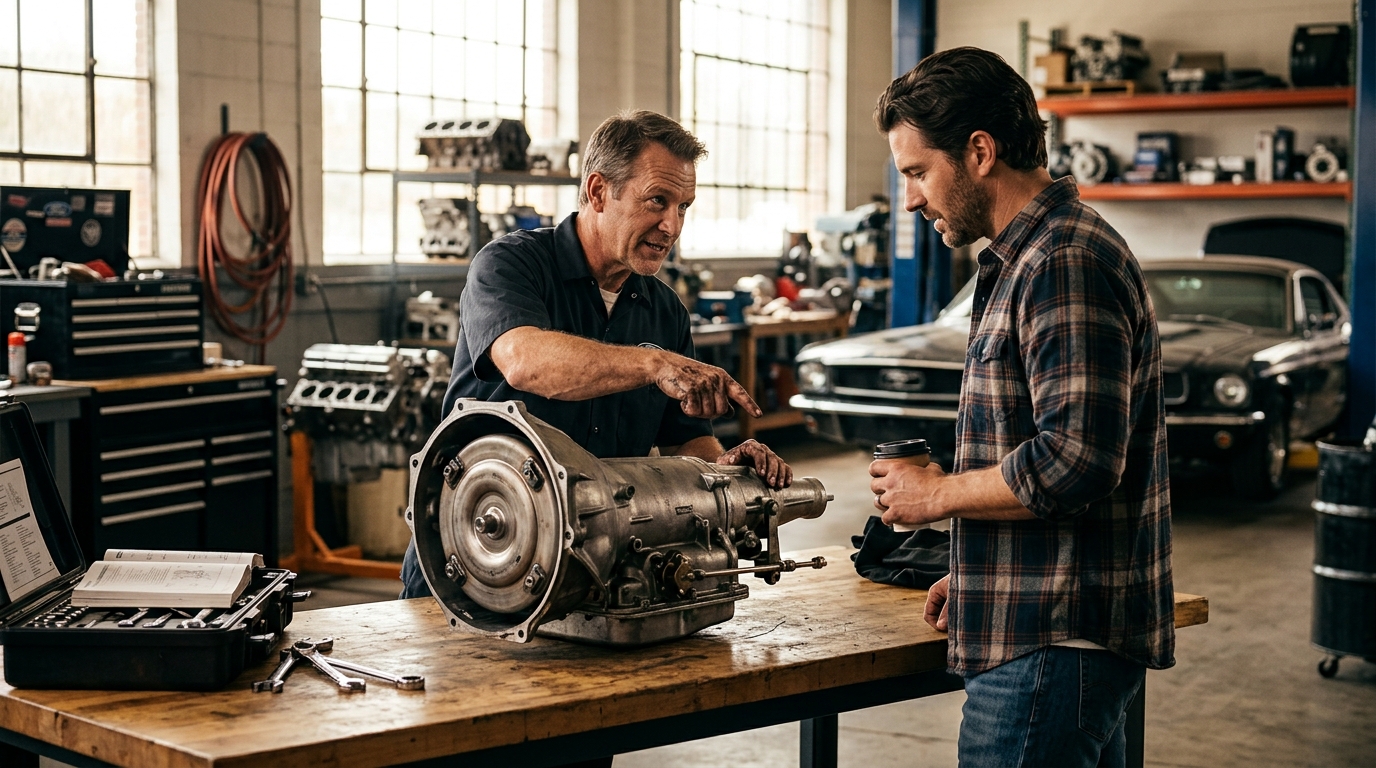
Choosing the correct transmission for a Ford vehicle is not merely a matter of bolt patterns or gear ratios. It is a fundamental engineering decision that dictates the longevity of your drivetrain, the responsiveness of your acceleration, and the overall safety of the vehicle under load. According to industry data on automotive failure rates, transmission-related issues account for a significant percentage of high-mileage repair costs, with improper gear ratio selection being a primary contributor to premature wear. This guide provides the essential criteria for selecting a Ford transmission based on your specific vehicle use and performance goals.
Understanding Ford Transmission Types
Ford has utilized a diverse array of transmission architectures over the decades. To make an informed decision, you must first identify the specific type of transmission that aligns with your engine platform and driving style. The Total Performance catalog highlights several critical categories.
Automatic Transmissions
Automatic transmissions are designed for convenience and durability in daily driving conditions. For classic Ford vehicles, such as those with the Ford 351C Cleveland engine, the C4, C6, and AOD transmissions are common stock units. Modern Ford applications often utilize the 4R70W or 6R80, which offer advanced electronic control and improved fuel efficiency. When selecting an automatic, consider the torque converter stall speed, which determines how quickly the engine reaches its power band. (Just a moment)
Manual Transmissions
Manual transmissions provide direct driver control and are often preferred for high-performance builds and racing applications. The Ford T5, TR-3650, and the newer MT82 are popular choices for Mustang and Bronco builds. Manual gearboxes generally handle higher torque loads more effectively than stock automatics because they lack the fluid coupling that can slip under extreme stress. However, they require more driver input and may not be ideal for heavy towing or stop-and-go traffic. (Total Performance Australia buy)
Transfer Cases and Four-Wheel Drive Systems
For off-road enthusiasts, the transmission selection must also account for the transfer case. Ford Bronco and F-Series trucks often require specific transfer cases to handle the increased stress of four-wheel drive operation. Upgrading to a heavy-duty transfer case is essential when increasing tire size or engine power.
Matching Gear Ratios to Vehicle Use
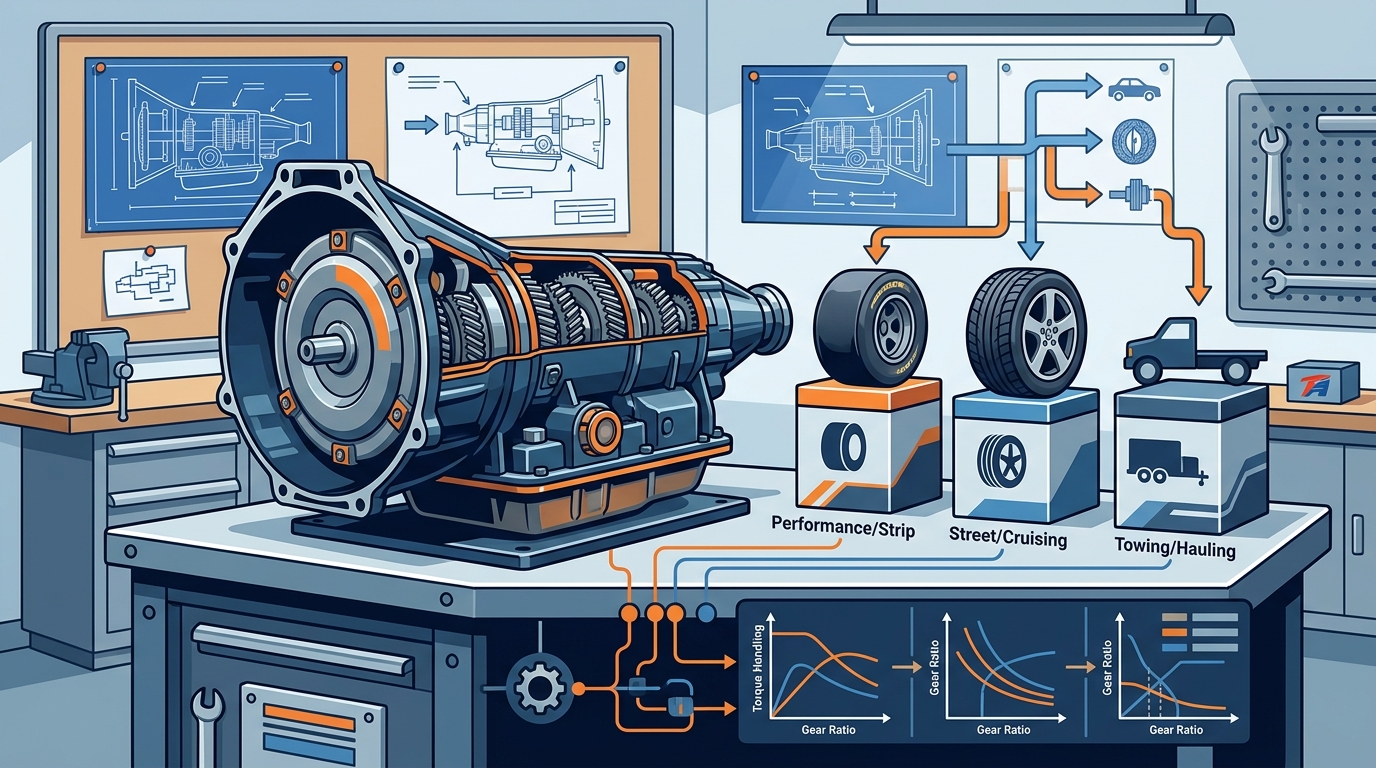
Gear ratios are the most critical factor in determining how your vehicle performs. The ratio dictates the multiplication of engine torque delivered to the wheels. Selecting the wrong ratio can lead to poor acceleration, excessive engine wear, or inadequate towing capacity.
Street and Strip Performance
For vehicles focused on street driving and occasional track use, a closer gear ratio is often beneficial. This keeps the engine in its peak power band during acceleration. For example, a Ford Coyote engine build might benefit from a transmission with a first gear ratio that allows for quick launches without stalling the engine. The goal is to minimize the time spent shifting while maximizing the time spent at peak horsepower.
Heavy Towing and Hauling
When towing heavy loads, a lower first gear ratio is essential to provide the initial torque needed to move the vehicle. Additionally, a higher overdrive ratio in the top gear helps reduce engine RPM during highway cruising, improving fuel economy and reducing heat buildup. Ford trucks equipped with the Ford FE 390 427 428 Big Block Engine Parts often require specific transmission setups to handle the massive torque output while towing.
Off-Roading and Rock Crawling
Off-road vehicles require extremely low first gear ratios and a robust transfer case. The ability to crawl at very low speeds without stalling is crucial for navigating difficult terrain. Many off-road enthusiasts opt for aftermarket transmissions with custom gear sets to achieve the necessary low-end torque multiplication.
Performance Goals and Torque Capacity
Your performance goals directly influence the strength requirements of your transmission. Stock transmissions are designed for factory power levels and may fail when subjected to increased horsepower and torque.
Stock vs. Aftermarket Strength
If you are building a high-horsepower engine, such as a Ford Modular 4.6L 5.4L Engine Parts swap, you must consider the torque capacity of the transmission. Stock gears and shafts may shear or break under high load. Aftermarket transmissions often feature hardened gears, reinforced shafts, and upgraded clutch packs to handle these forces.
Torque Converter Selection
For automatic transmissions, the torque converter is a critical component. A stall speed that matches your engine's power band is essential for optimal performance. A converter that stalls too low will result in sluggish acceleration, while one that stalls too high can cause excessive heat and wear. Total Performance offers a range of converters designed for specific applications.
Cooling and Reliability Factors
Heat is the enemy of all transmissions. Excessive heat degrades transmission fluid, leading to increased friction and wear on internal components. Proper cooling is essential for longevity, especially in high-performance or towing applications.
Transmission Coolers
Installing an auxiliary transmission cooler is a simple yet effective way to manage heat. For vehicles operating in hot climates or under heavy load, a cooler can significantly extend the life of the transmission fluid and internal components. Ford trucks and performance Mustangs often benefit from upgraded cooling systems.
Fluid Maintenance
Regular fluid changes are crucial for maintaining transmission health. Synthetic transmission fluids offer better thermal stability and lubrication properties than conventional fluids. Using the correct fluid type specified by Ford is essential for proper operation of electronic controls and clutch engagement.
Comparison of Transmission Options
The following table compares common Ford transmission options based on vehicle application, performance capability, and key features.
| Transmission Model | Vehicle Application | Performance Capability | Key Features |
|---|---|---|---|
| C6 Automatic | Classic Ford V8s (Mustang, Falcon) | High Torque Capacity | Durable, widely supported, manual shift capability |
| 4R70W Automatic | Ford F-Series, Mustang (1996-2007) | Medium to High | Electronic control, overdrive, robust for street builds |
| T5 Manual | Mustang (1983-1993), Bronco | Medium | Lightweight, common swap option, limited torque capacity |
| MT82 Manual | Mustang (2015+), Shelby GT350 | Very High | Active rev match, synchro-mesh rev matching, high strength |
| TR-3650 Manual | Mustang (1994-1995), Bronco | High | Stronger than T5, close-ratio gears, popular for swaps |
Key Takeaways
- Gear Ratio Selection: Match your gear ratios to your primary use case, whether it is street performance, towing, or off-roading.
- Torque Capacity: Ensure your transmission can handle the torque output of your engine, especially if you have upgraded components.
- Heat Management: Install adequate cooling systems to prevent transmission failure due to overheating.
- Fluid Maintenance: Use high-quality synthetic fluids and perform regular maintenance to extend transmission life.
- Compatibility: Verify bolt patterns, input shafts, and electronic compatibility when swapping transmissions.
- Professional Installation: Proper installation and alignment are critical for smooth operation and longevity.
- Expert Advice: Consult with specialists at Total Performance for tailored recommendations based on your specific build.
Frequently Asked Questions
How do I choose the right gear ratio for my Ford transmission?
Choose a lower first gear ratio for towing and off-roading to increase torque, and a higher overdrive ratio for highway cruising to improve fuel economy. For street performance, select a ratio that keeps the engine in its peak power band during acceleration.
What is the most durable Ford automatic transmission?
The C6 automatic is widely regarded as one of the most durable Ford automatic transmissions, particularly for classic V8 engines. It can handle high torque loads and is a popular choice for performance builds.
Can I use a manual transmission in my Ford Mustang?
Yes, many Ford Mustangs can be equipped with manual transmissions. Popular options include the T5, TR-3650, and MT82, depending on the model year and performance goals.
How often should I change my transmission fluid?
It is generally recommended to change transmission fluid every 30,000 to 60,000 miles, depending on driving conditions. Severe driving conditions, such as towing or frequent stop-and-go traffic, may require more frequent changes.
What is the difference between a stall speed and a gear ratio?
Stall speed refers to the RPM at which a torque converter begins to engage and transfer power, while gear ratio refers to the multiplication of torque provided by the transmission gears. Both are critical for performance but serve different functions.
Do I need an upgraded transmission cooler?
If you are towing heavy loads, driving in hot climates, or building a high-performance engine, an upgraded transmission cooler is highly recommended to prevent overheating and extend transmission life.
Where can I find high-quality Ford transmission parts?
Total Performance Australia offers a comprehensive range of Ford transmission parts, including converters, gears, and rebuild kits. Visit our transmission section to explore our inventory.
Shop Transmissions
Ready to upgrade your Ford's transmission? Explore our extensive collection of high-performance transmissions, torque converters, and related components at Total Performance Australia. Whether you are building a classic Mustang or a modern F-Series truck, we have the parts you need to achieve your performance goals. Contact our team for expert advice and support.