

Selecting the right V8 engine is the most critical decision in any high-performance automotive build. The choice dictates your vehicle's torque curve, horsepower potential, and long-term reliability. According to industry data, V8 engines continue to dominate the enthusiast market, with millions of units produced annually to support a massive aftermarket ecosystem. This guide analyzes the primary V8 architectures available today, helping you navigate the complex landscape of American muscle, European luxury, and Australian muscle. We will examine the technical nuances of each platform to ensure your build matches your specific performance goals.
The Chevy LS Family: The Aftermarket King
The Chevrolet Small Block V8, particularly the LS architecture, is widely regarded as the most versatile engine platform in automotive history. Its compact design, lightweight construction, and immense aftermarket support make it the default choice for swap enthusiasts worldwide. The LS family includes variants like the LS1, LS2, LS3, and the high-revving LS7. Each variant offers distinct advantages depending on your budget and power targets.
Why Choose an LS Engine?
The primary advantage of the LS platform is its modularity. The engine block is designed with a flat deck and a robust cross-bolted main cap structure, allowing it to handle significant horsepower increases with minimal internal modifications. According to performance data, a stock LS3 can reliably produce over 450 horsepower, while built versions routinely exceed 1,000 horsepower on pump gas. This reliability is due to the engine's efficient oiling system and durable casting quality.
When selecting an LS engine, you must consider the intake manifold compatibility. The LS platform uses a specific bolt pattern that differs from older Small Block Chevys. This means you will need to source compatible intake manifolds and throttle body spacers to ensure proper airflow. Additionally, the LS family benefits from a vast array of cylinder heads that can be swapped to alter airflow characteristics and power delivery.
LS Engine Variants Explained
The LS1, found in the Corvette C5 and Camaro Z28, is a solid-lifter engine known for its high-RPM power band. The LS2, used in the Corvette C6, features a larger displacement and improved breathing. For modern builds, the LS3 is the preferred choice due to its factory fuel injection and high-compression pistons. If you are looking for extreme performance, the LS7 offers a dry-sump oiling system and a 9,000 RPM redline, making it ideal for track-focused applications.
Ford Modular V8: Power and Precision
Ford's Modular V8 engine family represents a different engineering philosophy compared to the Chevrolet Small Block. The Modular V8 is characterized by its four-valve-per-cylinder head design, which allows for superior airflow at high RPMs. This architecture is found in the Ford Coyote, Boss, and various truck engines. The Modular V8 is known for its smooth power delivery and exceptional high-RPM performance.
Performance Characteristics
The Ford Modular V8 is often compared to the LS family in terms of power potential, but it offers a different driving experience. The four-valve heads provide a broader torque curve, making the engine more responsive in the mid-range RPMs. This makes the Modular V8 an excellent choice for street-driven vehicles that require both daily drivability and track performance. According to automotive engineering reports, the Coyote V8 can produce over 500 horsepower in its stock configuration, with significant headroom for forced induction upgrades.
When building with a Ford Modular V8, attention must be paid to the EFI systems and throttle bodies. The Modular V8 uses a specific sensor layout and wiring harness that differs from other platforms. Compatibility with aftermarket fuel pumps and regulators is crucial for maintaining proper fuel pressure under high load. Additionally, the Modular V8 benefits from specialized camshafts that can be swapped to alter valve timing and improve power output.
Modular V8 Applications
The Ford Modular V8 is found in a wide range of vehicles, from the Mustang GT to the F-150 Raptor. The Coyote V8, in particular, has become a popular swap engine due to its compact design and high power output. The Boss 302 variant offers a high-revving nature similar to the LS7, making it a favorite among track enthusiasts. For those seeking a more affordable option, the 4.6L Modular V8 from the Mustang GT provides a solid foundation for budget-conscious builds.
Holden V8: The Australian Icon
In Australia, the Holden V8 is a cultural icon and a cornerstone of the local performance scene. The Holden 308 V8, based on the Chevrolet Small Block design, has been adapted to suit Australian driving conditions and preferences. The Holden V8 is known for its robust construction and ability to handle high torque loads, making it ideal for towing and heavy-duty applications.
Holden 308 and 355 Engines
The Holden 308 V8 is a direct descendant of the Chevrolet Small Block, sharing many internal components and design principles. This compatibility makes it easy to source engine components and gaskets for maintenance and upgrades. The Holden 355 V8, a stroked version of the 308, offers increased displacement and torque, making it a popular choice for muscle car builds. According to local performance data, the Holden 355 can produce over 400 horsepower with minimal modifications.
When selecting a Holden V8, consider the transmission and torque converter compatibility. The Holden V8 is often paired with automatic transmissions, such as the TH350 or Powerglide, which require specific flexplates and bell housings. For manual transmission builds, you will need to source a compatible clutch and flywheel. Additionally, the Holden V8 benefits from specialized carburetors and fuel logs to ensure proper fuel delivery.
Holden V8 Aftermarket Support
The Holden V8 has a dedicated aftermarket support network in Australia, with numerous suppliers offering performance parts. From superchargers to nitrous systems, there are plenty of options to increase power output. The Holden V8 is also a popular choice for off-road builds, thanks to its durability and torque characteristics. For those seeking a unique build, the Holden V8 can be adapted to fit a wide range of vehicle platforms.
Chrysler Hemi: Torque and Tradition
The Chrysler Hemi V8 is renowned for its hemispherical combustion chambers, which provide superior airflow and efficiency. The Hemi architecture has been used in various Chrysler, Dodge, and Jeep vehicles, offering a blend of power and reliability. The Hemi V8 is known for its high torque output, making it ideal for towing and heavy-duty applications.
Hemi GEN III and Modern Variants
The Hemi GEN III, including the 5.7L, 6.1L, and 6.4L variants, represents the modern evolution of the Hemi V8. These engines feature advanced fuel injection systems and variable valve timing, which improve both power and fuel efficiency. According to performance studies, the Hemi GEN III can produce over 470 horsepower in its stock configuration, with significant headroom for upgrades. The Hemi's robust block design allows for high-compression pistons and aggressive cam profiles.
When building with a Hemi V8, attention must be paid to the ignition components and distributors. The Hemi V8 uses a specific coil-on-plug or distributor-based ignition system that requires compatible parts. Additionally, the Hemi benefits from specialized extractors and headers to maximize exhaust flow and power output. For those seeking forced induction, the Hemi V8 is an excellent candidate for supercharger or turbo kits.
Hemi V8 Applications
The Chrysler Hemi V8 is found in a wide range of vehicles, from the Dodge Charger to the Jeep Grand Cherokee. The Hemi's versatility makes it a popular choice for both street and off-road builds. For those seeking a high-performance build, the Hellcat and Demon variants offer supercharged power outputs exceeding 700 horsepower. These engines are ideal for drag racing and track applications, thanks to their robust internal components and advanced cooling systems.
Comparing V8 Platforms
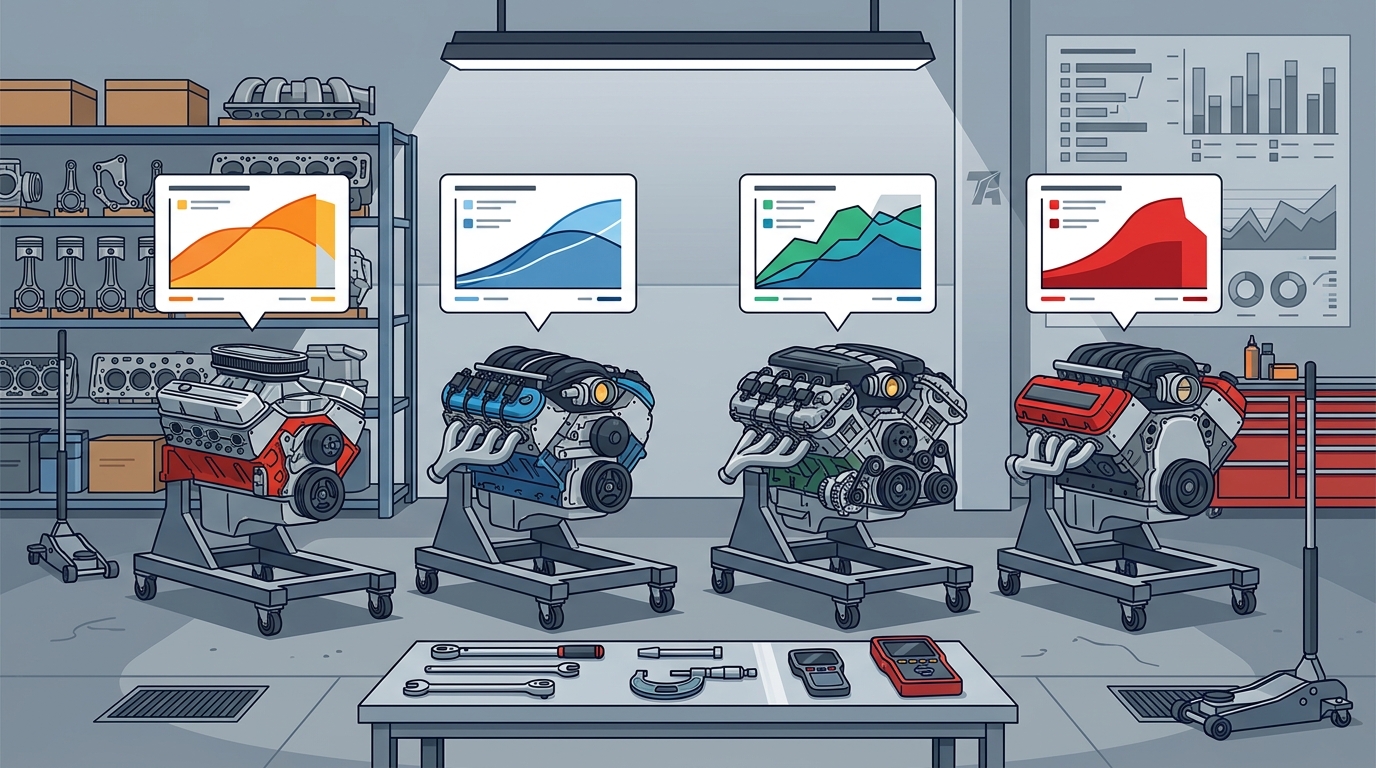
Selecting the right V8 engine requires a careful comparison of the available platforms. Each engine family offers distinct advantages and disadvantages, depending on your specific needs. The table below summarizes the key characteristics of the Chevy LS, Ford Modular, Holden V8, and Chrysler Hemi platforms.
| Engine Platform | Key Strength | Aftermarket Support | Best For | Typical Power Range |
|---|---|---|---|---|
| Chevy LS | Versatility & Cost | Extensive | Swaps & Budget Builds | 400 - 1,000+ HP |
| Ford Modular | High-RPM Power | Strong | Street & Track | 450 - 800+ HP |
| Holden V8 | Torque & Durability | Regional | Towing & Muscle | 350 - 600+ HP |
| Chrysler Hemi | Torque & Efficiency | Strong | Towing & Drag | 450 - 800+ HP |
Key Takeaways
- The Chevy LS family offers the most extensive aftermarket support and versatility for custom builds.
- Ford's Modular V8 excels in high-RPM power delivery and is ideal for performance-oriented street builds.
- The Holden V8 is a durable and torque-rich option, particularly suited for Australian muscle car enthusiasts.
- Chrysler's Hemi V8 provides exceptional torque and efficiency, making it a top choice for towing and drag racing.
- Compatibility of transmissions, torque converters, and ignition components is critical for successful engine swaps.
- Proper fuel systems and carburetors must be selected to match the engine's airflow requirements.
- Each V8 platform has unique camshafts and cylinder heads that can be upgraded to enhance performance.
Frequently Asked Questions
What is the most reliable V8 engine for a daily driver?
The Ford Modular V8 is often cited as one of the most reliable V8 engines for daily driving due to its smooth power delivery and robust internal components. Its four-valve head design allows for efficient combustion, reducing wear and tear over time. Additionally, the availability of gaskets and seals ensures that maintenance is straightforward and cost-effective.
Can I swap a Chevy LS engine into any vehicle?
While the Chevy LS engine is highly versatile, swapping it into any vehicle requires careful consideration of mounting points, transmission compatibility, and electrical integration. The LS platform's compact design makes it easier to fit in tight engine bays, but you may need custom motor mounts and exhaust systems to complete the installation.
What is the difference between a stroker kit and a standard engine?
A stroker kit increases an engine's displacement by using a crankshaft with a longer throw and connecting rods with modified dimensions. This results in increased torque and horsepower compared to a standard engine. Stroker kits are commonly used in Chevy and Holden builds to enhance low-end power.
How do I choose the right carburetor for my V8?
Selecting the right carburetor depends on your engine's displacement, intended power output, and driving conditions. A general rule of thumb is to choose a carburetor with a flow rate of approximately one CFM per cubic inch of engine displacement. For high-performance builds, consider EFI systems for more precise fuel delivery.
What are the best superchargers for a V8 engine?
The best superchargers for a V8 engine depend on the specific engine platform and your power goals. Root-type superchargers are ideal for low-RPM torque, while screw-type superchargers offer better high-RPM performance. Ensure that the supercharger is compatible with your engine's intake manifold and throttle body.
Is it worth upgrading to a dry-sump oiling system?
Upgrading to a dry-sump oiling system is highly recommended for high-performance and track-focused builds. Dry-sump systems prevent oil starvation during high-G cornering and allow for a lower engine installation, which improves the vehicle's center of gravity. This upgrade is particularly beneficial for Chevy LS and Ford Modular engines.
What maintenance is required for a high-performance V8?
High-performance V8 engines require regular maintenance, including oil changes, spark plug replacements, and ignition component inspections. Using high-quality oils and additives is crucial to protect the engine from wear and heat. Additionally, monitoring cooling systems and water pumps ensures optimal operating temperatures.
Start Your Build
Selecting the right V8 engine is the first step toward building a high-performance vehicle that meets your specific needs. Whether you choose the versatile Chevy LS, the high-revving Ford Modular, the durable Holden V8, or the torque-rich Chrysler Hemi, each platform offers unique advantages. Visit Total Performance Australia to explore our extensive range of engine parts, transmissions, and performance accessories. Our team of experts is ready to help you find the perfect components for your build. Contact us today to start your journey toward automotive excellence.